
The Karnataka high court, which dismissed a batch of petitions by some Muslim girls from Udupi seeking permission to wear the hijab inside classrooms of educational institutions, framed the entire case in the form of four questions and answered them accordingly.

Challenging the government order restricting the use of any cloth that can disturb peace, harmony and, law and order, the girls who petitioned in favour of hijab requested the Karnataka high court on Monday to allow them to wear Islamic headscarves of the colour of the school uniform.

The Muslim Rashtriya Manch, the Rashtriya Swayamsevak Sangh's Muslim wing, has backed the burqa-clad student who was heckled by youth shouting 'Jai Shri Ram' slogans at a Karnataka college, saying 'purdah' is a part of Indian culture.

The Law Commission has said it is of the considered view that Section 124A of the Indian Penal Code dealing with sedition needs to be retained, though certain amendments could be introduced to bring about greater clarity regarding usage of the provision.
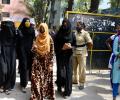
Karnataka has told the high court that its order dated February 5 did not ban the headscarf but only delegated the powers to decide the school uniform to the college development committees.

The single judge of the Karnataka high court hearing the case related to the 'hijab' ban in school-college campuses referred the matter to Chief Justice Ritu Raj Awasthi on Wednesday with a view that the CJ may decide on constituting a larger bench to look into the case.
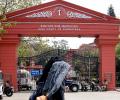
The Karnataka high court, which dismissed the batch of petitions by some Muslim girl students from Udupi seeking permission to wear the hijab inside classrooms, said there was no material placed on record to prima facie show that wearing the headscarf was an essential religious practice.

They also requested the full bench of the HC to make a leeway to attend classes with headscarves as the court's interim order had suspended their 'fundamental rights'.

'These are the people who don't want peace in the state, who want to disturb the harmony in the state.'

The court directed the Congress to explain whether they were adhering to COVID norms such as wearing face masks, and maintaining social distancing.

The Karnataka high court on Friday said it has called for a report from the state government on the role of radical organisations behind the hijab controversy in the state.
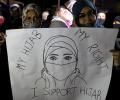
The appeal contended that the high court has sought to curtail the fundamental right of Muslim student women by not allowing them to wear the hijab.
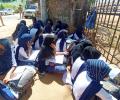
"The consequence of the demand to declare Hijab as an essential religious practice is huge because there is an element of compulsion or else you will be expelled from the community," Navadgi told the court.
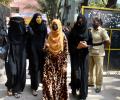
"This is our stand that hijab is not an essential religious practice. There was a statement by Dr B R Ambedkar in the Constituent Assembly where he said 'let us keep the religious instructions outside educational institutions'," Karnataka Advocate General Prabhuling Navadgi told the full bench of the high court, which is hearing the hijab case.

He will be holding a meeting with Ministers of Education and Home departments and officials later in the day aimed at taking certain measures to restore cordial and peaceful atmosphere and discipline at educational institutions.

The Maari Gudi temple management at Kapu town in Udupi district of coastal Karnataka has decided not to allow 'people from other faith' to do business on its land during the annual temple festival on the request of certain pro-Hindu organisations.
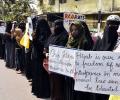
The Karnataka high court on Tuesday dismissed petitions filed by a section of Muslim students from the Government Pre-University Girls College in Udupi, seeking permission to wear the hijab inside the classroom.

Of the total 166 names declared so far by the Congress, 119 candidates will be making their electoral debut.
 © 2026 Rediff.com - Advertise with us - Disclaimer - Privacy Policy - Sitemap - Feedback - About us - Terms of use - Grievances